
For any management consultant, tackling a client's complex business issue starts with two critical steps: deeply understanding the problem and defining a clear methodology. This initial groundwork is pivotal, setting the direction for the entire engagement.
In a previous article, I highlighted how n8n streamlines prototyping AI workflows, enabling rapid iteration. This piece builds on that, showcasing a more sophisticated, step-by-step AI workflow for defining project methodologies.
This workflow can be a valuable tool for both students learning the ropes of consultancy and for practicing consultants.
For students, it offers an interactive way to grasp how to systematically deconstruct client issues, define robust actions, structure project plans, and outline key meetings and deliverables, with an AI co-pilot guiding them.
Practicing consultants can also leverage this approach as a starting point or a brainstorming aid, though for direct application in client engagements, it would naturally require more work and fine-tuning to integrate their firm's internal knowledge, specific know-how, best practices, and proprietary documents.
The core idea isn't just to generate an AI output, but to illuminate the process of methodology creation. It's about learning to critique, refine, and understand how various components of a project plan interlink.
1. The Limitations of a Single Prompt
Here is an example of what a single-prompt approach might look like:
You are an expert management consultant tasked with designing a comprehensive, strategic consulting methodology tailored to address the following business issue:

[CLIENT'S BUSINESS ISSUE]

Your output must be a fully integrated, end-to-end consulting methodology structured into clearly defined phases. For each phase, include:
- A concise goal statement explaining what the phase aims to achieve
- A brief description elaborating on the focus and approach of the phase
- A logically sequenced list of key consulting actions to be undertaken, with each action clearly explained and linked to advancing resolution of the business issue
- Identification of necessary client-facing meetings and workshops, including their purpose and key participants
- Tangible deliverables that mark progress and add value to the client, with explanations of their purpose

Ensure the methodology covers all critical elements from diagnosis through solution design, implementation, and monitoring. Show logical sequencing and dependencies between phases and highlight where parallel work is possible. The methodology must be strategic, practical, and directly aligned with resolving the stated business issue.
Relying on a single, direct instruction for a large language model (LLM) to generate a complex methodology may seem straightforward, but it has many drawbacks:
- Superficial & Inconsistent Results: Produces generic outputs that lack depth and struggle to maintain a consistent focus.
- Inefficient to Refine: Lacks a built-in cycle for refinement, requiring a complete restart to make any adjustments.
- Poor for Learning: Bypasses skill development by delivering a final answer without showing how it was constructed.
- Unreliable for Complexity: Increases the risk of errors and makes quality control more difficult.
Ultimately, no effective consultant develops a final methodology immediately after an initial look at a client's problem. The process requires a more deliberate and structured approach.
2. The AI-Powered Methodology Workflow
I've developed an automated workflow, which I built using n8n, that takes a user-defined business issue and guides it through several stages of AI-powered analysis and generation, culminating in a detailed, structured methodology.
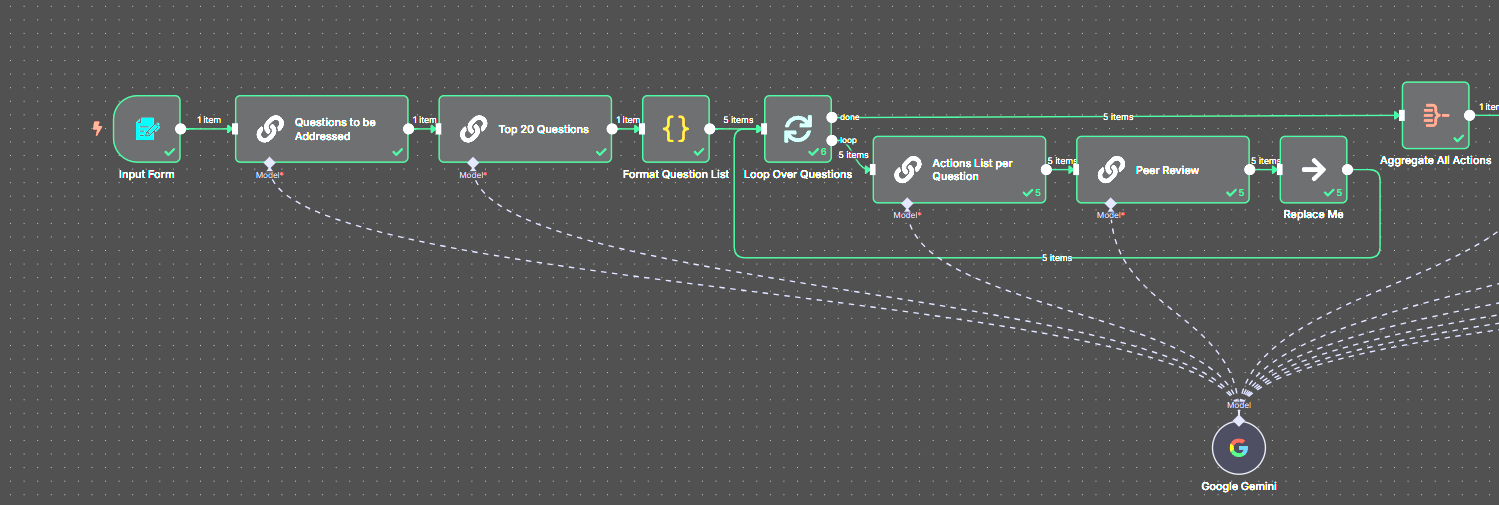
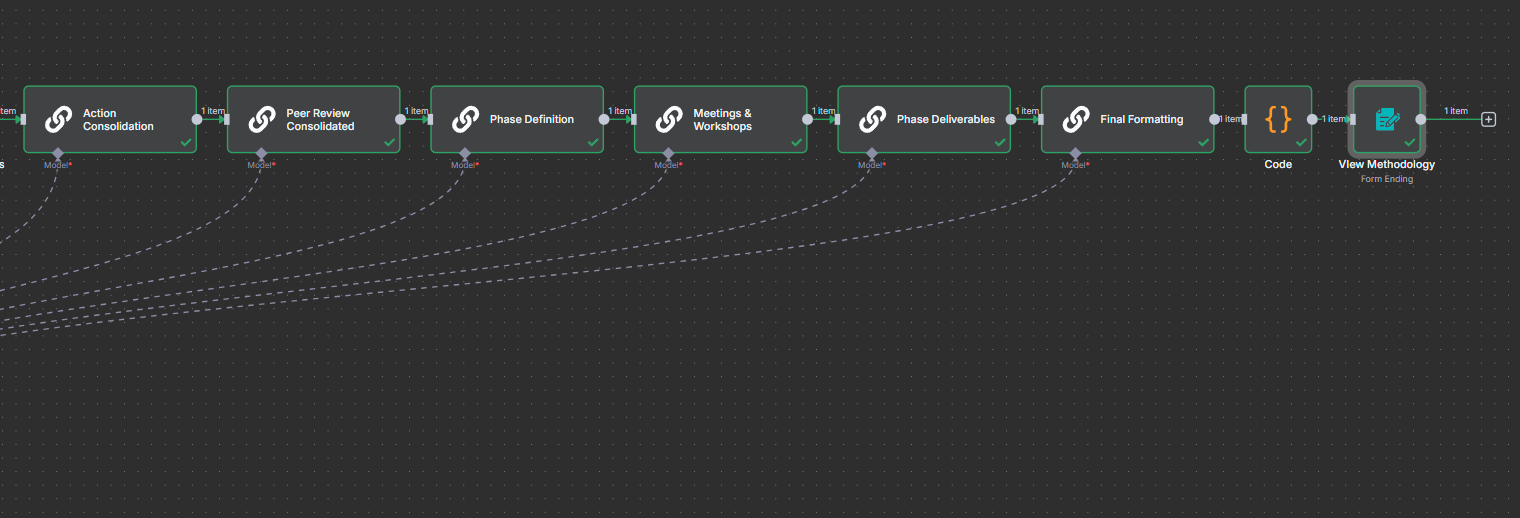
The workflow itself consists of several interconnected automated stages, each performing a specific task, often leveraging an LLM with a carefully crafted persona and instructions (example prompts are shared at each step):
Step 1:
The Workflow:
Input Business Issue: The process starts with the user inputting a client's business issue (e.g., "Declining market share for Product X," "Inefficient internal processes leading to delays"). AI Brainstorms Extensive Questions (example prompt): An AI, acting as a "Senior Management Consultant," analyzes the issue and generates a comprehensive list of investigatory questions. The goal here is breadth, covering all potential angles. AI Prioritizes to Critical Questions (example prompt): A second AI reviews this extensive list and narrows it down to the 20 most critical and foundational questions that need to be addressed first.
Learning & Improvement Opportunities:
- Boost Relevance with Contextual Data (RAG): Improve AI question generation by providing access to past project scopes or industry-specific frameworks.
- Validate AI Prioritization: Assess the strategic importance of AI's "critical" questions against project goals and expert judgment.
- Refine Prioritization via Fine-Tuning & Explainability: Task AI to explain its rationale; fine-tune the LLM on successful past project data for better strategic alignment; ask the user to prioritize themselves.
- Manually Refine & Apply Expertise: Users should actively edit the AI's question list, using the AI output as a starting point to apply their expert refinement and insights.
- Enable Continuous Learning through Feedback: Use manually curated question lists as few-shot examples for the LLM to progressively enhance future outputs.
Step 2: Developing Initial Actions
The Workflow:
Looping Through Key Questions: The workflow iterates through each of the prioritized critical questions. AI Proposes Actions (example prompt): For each question, an AI persona (e.g., "Experienced Management Consultant") generates a concise list of primary actions to explore that specific question, explaining why each action is crucial. AI "Peer Reviews" Actions (example prompt): The proposed action plan for that single question is then passed to another AI, acting as a "Critical Friend" or QA expert. This AI reviews the plan, suggests improvements, adds comments, and aims for pragmatic enhancements, preserving sound original actions.
Learning & Improvement Opportunities:
- Analyze & Contextualize Action Formulation: Learn SMART actions and assess AI proposals for practicality and resource feasibility; provide the LLM access to firm-specific engagement activities or case studies (RAG) for more aligned action suggestions.
- Leverage AI "Peer Review": Understand constructive criticism and use AI review as a baseline quality check; fine-tune the "Peer Review" AI on high-quality internal reviews or firm-specific quality checklists for more valuable feedback.
- Manually Adjust and Augment Actions: Users should critically review the AI-generated (and peer-reviewed) actions, then directly edit, add, or remove actions based on their expert judgment and specific project requirements.
Step 3: Consolidating & Refining the Action Plan
The Workflow:
Aggregate All Actions: All the peer-reviewed action plans (one set for each critical question) are collected. AI Consolidates into Master Plan (example prompt): An AI focused on synthesis reviews the aggregated list, de-duplicates redundant actions, merges related tasks, and refines them into a single, coherent "Final Master Action Plan" aligned with the overall business issue. This AI also provides notes on its consolidation rationale. Final AI "Peer Review" of Consolidated Plan (example prompt): This Master Action Plan undergoes one more quality check by a "Critical Friend" AI to ensure overall completeness, clarity, strategic relevance, and internal consistency.
Learning & Improvement Opportunities:
- Evaluate AI's Synthesis and De-duplication Logic: Scrutinize how the AI consolidates actions, ensuring efficiency and identifying potential missed synergies or over-aggressive merging. The AI could be trained with examples of well-structured vs. poorly structured plans to improve this.
- Directly Modify and Enhance the Master Plan: Users should actively adjust the AI-consolidated plan, re-prioritizing, re-framing actions, or adding new ones as needed to perfectly match strategic goals and practical constraints.
- Appreciate and Enhance Macro-Level Review: Recognize the importance of a final holistic check. The AI peer review could use a dynamic quality checklist, updated from past workflow insights or specific client needs.
Step 4: Structuring the Project
The Workflow:
AI Defines Project Phases (example prompt): The reviewed Master Action Plan is passed to an AI skilled in project structuring. This AI organizes the actions into logical project phases (e.g., Phase 1: Diagnostic & Assessment, Phase 2: Solution Design, etc.). Details for Each Phase: For each phase, the AI details its title, primary goal, a brief description, the actions assigned to it, key dependencies (inputs/outputs), and potential for concurrent execution with other phases.
Learning & Improvement Opportunities:
- Assess and Align Phasing Principles: Evaluate the AI's proposed phasing against standard project management practices and firm-specific methodologies.
- Manually Adapt Phasing and Structure: Users should review the AI's proposed project structure and manually adjust phase definitions, action assignments, or dependencies to better reflect project realities or preferred methodologies.
- Validate Dependencies and Critical Path: Apply a practical lens to the AI's dependency mapping. The AI could visually map dependencies or highlight critical path items to aid review.
Step 5: Planning Meetings & Defining Deliverables
The Workflow:
AI Identifies Meetings & Workshops (example prompt): Using the phased plan, an AI identifies necessary client-facing and internal team meetings/workshops for each phase, outlining their objectives and key participants. AI Outlines Key Deliverables (example prompt): Another AI then details the key tangible deliverables for each phase (e.g., "Diagnostic Report," "Recommendation Presentation," "Implementation Roadmap"), explaining their purpose and content.
Learning & Improvement Opportunities:
- Customize Engagements and Deliverables: Users should take the AI's suggestions for meetings, workshops, and deliverables, and manually tailor them to specific stakeholder needs, client preferences, or SOW requirements.
- Ensure Deliverable Value, Alignment, and Quality: Verify that AI-suggested deliverables provide tangible value and meet client/SOW needs. The LLM could be fine-tuned on high-quality firm deliverables or use a checklist for comprehensive content.
Step 6: Formatting The Output
The Workflow:
AI Generates Formatted HTML Methodology (example prompt): All the structured information is compiled by an AI specializing in HTML generation, producing a clean, readable document.
Learning & Improvement Opportunities:
- Utilize as an Accelerated Draft & Learning Tool: The output serves as a rapid first draft for professionals and a concrete example for learners. The HTML could be enhanced with interactive elements or links to internal knowledge bases.
- Evaluate and Standardize Professional Presentation: Assess if AI formatting meets professional standards. The AI could offer styling options or be trained on corporate branding guidelines.
Now as as you might imagine, all of the prompts I provided are initial examples that need to be refined depending on the implementation. My aim was to illustrate what these prompts look like.
3. Interactive Learning with AI Workflows
A step-by-step AI workflow, like the one outlined, serves as a blueprint for interactive education, particularly for fields requiring problem-solving skills such as consulting, project management, and strategic planning. Its value lies in several key areas:
- Experiential Learning: Unlike passively consuming theoretical frameworks, this AI-assisted approach allows users to actively participate in creating a methodology, bridging the gap between theory and real-world application.
- Safe Experimentation: Users can input various business scenarios and observe diverse AI responses in a risk-free "sandbox," enabling them to test hypotheses and understand the impact of different inputs.
- Critical Co-creation: The multi-stage process encourages users to review, critique, question assumptions, and suggest improvements at each AI output stage. This transforms them into active co-creators, fostering deeper understanding and ownership.
- Demystifying Complexity: By breaking down a large task (like methodology definition) into manageable components, users learn the "why" behind each element and grasp their interdependencies.
- Process Transparency: The distinct roles of AI agents (or automated stages) within the workflow make the "thinking process" more observable and instructive compared to a single, opaque prompt.
The principles of this interactive AI workflow extend to teaching other complex skills. For instance, it can guide users through:
- Strategic Planning: From SWOT analysis, to generating objectives and initiative roadmaps, to scenario planning (an idea I explored in a previous article).
- Financial Modeling: Structuring business plans step-by-step.
- Market Research Analysis: Synthesizing data into summaries for critique.
- Other Complex Tasks: Including legal document drafting, scientific research design, complex decision-making, software requirements, etc.
In these applications, AI acts as a structured brainstorming partner or drafter, while the user retains responsibility for critical evaluation and refinement.
Conclusion
Moving beyond simplistic single-prompt AI interactions opens vast possibilities for teaching complex skills. A structured, multi-stage AI workflow provides an unparalleled interactive environment to learn the art and science of methodology definition.
By guiding users through the process, it encourages critical thought and prepares them for real-world professional challenges. This approach, where AI serves as a co-pilot and a Socratic guide, marks a significant step forward in training future professionals.