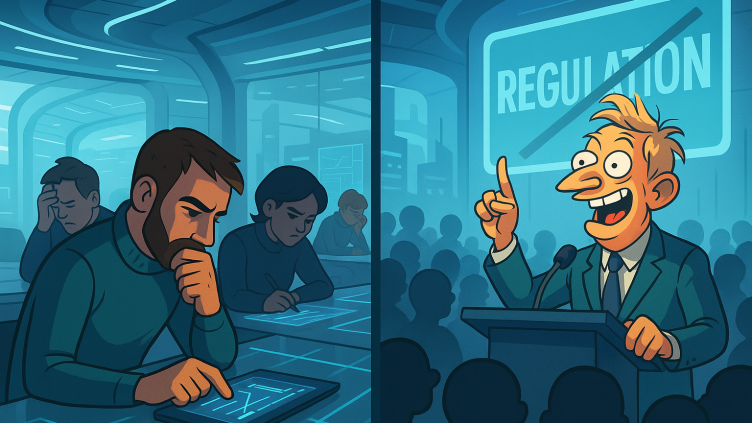
A recent study from Apple, dissecting the capabilities of Large Reasoning Models, has predictably sent ripples across the digital world.
The paper, with a very provocative title, The Illusion of Thinking, reveals that while these specialized AI models can handle moderately complex problems, they falter when faced with true complexity.
I am not going to spend too much time criticizing this study. But in short, while Apple's raw findings and data are very interesting, the hasty conclusions, the provocative title and the timing seem to serve ulterior motives.
But this has thrown fresh fuel on an old fire, reigniting the passionate, polarized debate: Can machines really think? Can they really reason? The answers almost always come in two flavors: a definitive "Yes" or strong "No."
The "No" camp is quick to deploy a familiar set of arguments. AI, they say, is "just math." It's sophisticated statistical mimicry, a high-speed pattern-matcher doing what it's told. It's just 1s and 0s, shortcuts, and clever programming.
The "Yes" camp often leaps ahead, attributing superior qualities that AI does not have. Qualities that we have yet to fully define or prove even in humans.
Yet, in this rush to judgment, a crucial first step is almost always skipped. We passionately debate whether machines can "think" or "reason" without bothering to define what we mean by those words. Even the Apple study, doesn't offer a formal definition of the very "thinking" it finds AI models incapable of.
This is where the popular arguments against AI begin to look fragile. Consider the dismissive phrase "AI is just...". Now try a simple substitution "Humans are just...":
Humans are just a bundle of heuristics, biases, and learned patterns. They are just masters of mimicry, making predictions based on past experiences.
Suddenly, the statements don't seem so reductive; they seem uncomfortably accurate, echoing decades of findings in cognitive psychology and neuroscience.
In this essay, I will step back from the binary "Yes/No" shouting match, and instead of starting with the machine, we will start with ourselves.
I will do my best to set aside my personal opinion, we will turn to the worlds of psychology, neuroscience, and philosophy to establish a more honest benchmark. It will seem like an appeal to authority, but it is not my authority I lean on. It is the authority of thinkers who have dedicated their lives to understanding the messy, yet brilliant, and often surprisingly simple machinery of the human mind. Only then can we begin to have a meaningful conversation about the illusion, or reality, of thinking machines.
I. The Philosophical Foundation: Dismantling the Myth of Pure Reason
Before asking whether machines can think, we must define thinking itself. Let me offer a working definition:
Thinking is the mental process of forming ideas, making sense of inputs, and solving problems.
This definition, loosely adapted from the American Psychological Association's definition, captures an intuitive understanding of human cognition. While it immediately raises more questions "What does forming ideas mean?" or "How do we define making sense"?, this definition has the advantage of staying grounded in observable processes that can be analyzed and compared, rather than concepts that are too abstract to be studied.
This definitional challenge reveals something important: perhaps thinking is far messier and less unified than we assume. Philosophers across cultures and centuries have systematically challenged our assumptions about human cognition, revealing that what we call "pure reason" may be far less special than we imagine.
1. Descartes' Seductive Illusion
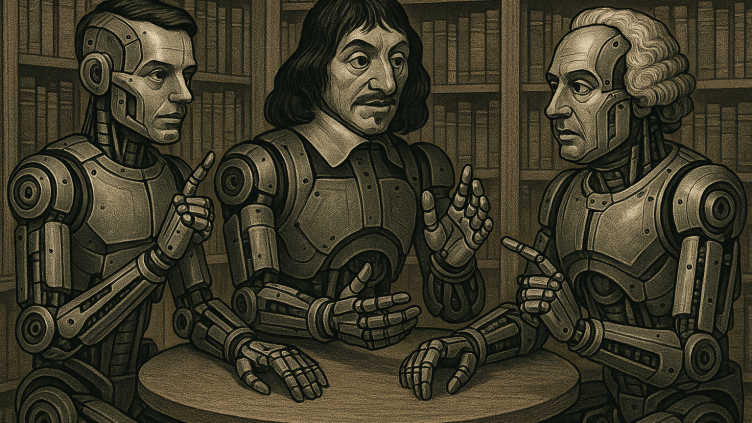
René Descartes gave us perhaps the most famous declaration of human rational supremacy: Cogito ergo sum i.e. "I think, therefore I am." But to understand the full scope of his claim about human exceptionalism, we need to examine how he defined thinking itself.
Descartes defined thought remarkably broadly:
By the word thought, I understand all that which so takes place in us that we of ourselves are immediately conscious of it; and, accordingly, all the operations of the will, the understanding, the imagination, and the senses, are thoughts.
Thus, for Descartes, thinking encompasses all forms of conscious mental activity, not just logical reasoning or inner dialogue, but also imagining, sensing, and willing. This broad definition makes thinking the defining feature of the mind in his dualist philosophy. For Descartes, the nature of the mind is to think; anything that does not think is not a mind.
But this definition contains several problematic assumptions that reveal Descartes' overconfidence in human self-knowledge (including his own). First, it assumes we can clearly define consciousness itself, something that remains one of philosophy's hardest problems centuries later. Second, it treats consciousness as a deliberate, unified process rather than considering the possibility that it might be an illusion or emergent property of simpler mechanisms. Most critically, Descartes assumes that thinking takes place entirely within the conscious realm and that we are aware of our mental processes as they happen. Modern neuroscience and psychology have thoroughly debunked this last assumption.
By making thinking the foundation of existence itself, Descartes positioned humans as possessing something fundamentally special: a rational faculty that could systematically doubt everything except its own existence, then build all knowledge through careful logical deduction.
But here's where Descartes' overestimation of human cognitive qualities becomes even more apparent. Having elevated thinking to such rarefied heights, he found himself unable to ground these mental capacities in the physical realm. The mind, for Descartes, had to be a separate, non-physical substance, completely distinct from the mechanical operations of the body and material world.
Even more revealing of Descartes' overconfidence in human rationality is his "proof" of God's existence. Descartes felt compelled to demonstrate that this amazing rational faculty could deduce the existence of God through pure logic. His argument goes something like this: we finite creatures have an idea of infinity and perfection (God). But since we are finite and imperfect beings, we could not have generated this idea of infinity or perfection ourselves. Finite minds cannot create the concept of infinity. Imperfect beings cannot imagine on their own a perfect deity. Therefore, this idea must have been placed in us by an actually infinite and perfect being. God himself.
A demonstration worthy of AI hallucinations. If you're tempted to accept this reasoning, consider that perfection and infinity are very easy to define and conceptually understand: perfection is the absence of faults, which we can easily observe, and infinity is the absence of limits, something we can easily observe as well. Imagining the absence of concepts we can observe does not require divine intervention. If a mind like mine can write it, a mind as brilliant as Descartes' could easily understand it.
However, this "rational demonstration" reveals just how far Descartes' confidence in human cognitive abilities, his cognitive abilities, had led him astray. He was so convinced of the power of his incredible reasoning that he believed it could logically prove the existence of the divine. The very fact that Descartes needed such elaborate metaphysical gymnastics to make his system work, demonstrates the problem with overestimating human cognitive specialness.
This Cartesian legacy, the notion that human reasoning is fundamentally different from and superior to mere physical processes, continues to influence how we think about intelligence today. It's the philosophical foundation underlying modern claims that human cognition is categorically different from computational processes.
But Descartes' confidence in pure reason set humanity up for a spectacular philosophical fall.
2. Hume's Devastating Critique
David Hume, writing a century after Descartes, systematically demolished the Cartesian temple of pure reason. His arguments undermined the very foundation of human rational exceptionalism that Descartes had constructed.
Learning Through Observation
Hume's most devastating insight was that, when it comes to "thinking", humans learn everything through observation and repetition, not through innate rational faculties. We don't come into the world with logical principles or rational capabilities, we develop all our beliefs and thinking patterns through repeated exposure to experiences.
When a child learns that fire burns, they're not applying logical reasoning: they're forming associations based on repeated sensory experiences. When we learn language, mathematics, or moral principles, we're building up complex webs of associations from countless observations. What we call "understanding" is really just the accumulation of experiential patterns.
This process is fundamentally non-rational. There's no special reasoning faculty guiding this learning, just the mind's tendency to form stronger associations based on repeated pairings of experiences. Hume argued that even our most sophisticated beliefs about causation, morality, and logic emerge from this basic associative learning process.
Complex Reasoning as Composition of Simple Thoughts
Building on this foundation, Hume demonstrated how what we call "complex reasoning" is really just the combination and recombination of simpler learned associations. As he put it:
Thus we find, that all simple ideas and impressions resemble each other; and as the complex are formed from them, we may affirm in general, that these two species of perception are exactly correspondent.
For Hume, "complex ideas are ensembles of simple ideas" meaning that even our most sophisticated reasoning is built by combining simpler learned patterns. Abstract mathematical concepts emerge from combining basic numerical associations learned through counting objects. Moral reasoning develops by linking together emotional responses we've learned to associate with different behaviors through social observation.
Since Hume thinks that every idea is either simple or complex, and that a complex idea is entirely made up of simple ones, it follows that every idea is either an exact copy of an impression, or is entirely made up of such copies. This means that even sophisticated philosophical arguments are constructed by chaining together simpler ideas that we've acquired through experience. When we think we're engaging in pure logical deduction, we're actually connecting concepts that we've learned to associate through repeated exposure.
This compositional process explains how humans can seem to engage in novel reasoning while still operating entirely through learned associations. We're not creating genuinely new logical principles, we're recombining existing mental patterns in ways that feel creative but are actually sophisticated pattern-matching and association.
Causation as Mental Habit
What we call "cause and effect" is simply the result of observational learning. When we see one billiard ball strike another and the second ball moves, we don't observe some mystical causal force, we observe a sequence that our minds have learned to associate through repetition. Our sense of causation comes from mental habits formed through repeated observations of similar sequences.
This reveals that what we consider rational analysis is actually pattern recognition. We've observed certain sequences so many times that we expect them to continue, not because logic tells us they must, but because our minds have been conditioned through repetition.
Remarkably, quantum physics has demonstrated that our understanding of cause and effect in the natural world is often shaped by what we are able to observe and measure, rather than reflecting the true nature of reality. What we think we know about causation changes as soon as we develop better tools and methods, suggesting that our confident sense of "understanding" the world may be more about the limitations of our observational capabilities than about grasping fundamental truths.
Reason as "Slave to the Passions"
Perhaps most deflating to human rational pride, Hume declared that :
Reason is, and ought only to be the slave of the passions.
Reason doesn't drive human behavior, it serves our desires, emotions, and inclinations. We don't rationally deliberate and then act; we feel inclined toward certain outcomes and then use reasoning to justify and achieve them.
This reveals that even our capacity for logical thought is not an independent faculty but a tool that serves non-rational drives and learned preferences. What we call "rational decision-making" is really the application of learned patterns in service of emotional and motivational states that we've developed through observation and experience.
The Humean Verdict
Hume's analysis reveals that human thinking is not the operation of special rational faculties, but rather the complex result of:
Associative learning from repeated observationsHabit formation through repetitive exposureCompositional combination of simpler learned thoughtsEmotional and motivational drives shaped by past experiences
In essence, humans are sophisticated learning machines that develop all their cognitive capabilities through observation and repetition. There's nothing mystical or uniquely rational about this process, it's statistical learning dressed up in philosophical language.
3. Broader Philosophical Perspectives
While European philosophy was wrestling with the nature of rational thought, other traditions were approaching the question from radically different angles, often arriving at conclusions that further deflate claims about human cognitive specialness.
Ibn Khaldun's Social Psychology
The 14th-century Arab historian Ibn Khaldun provided insights that wouldn't look out of place in modern social psychology. He observed that human thinking and behavior are fundamentally shaped by group dynamics, social solidarity, and collective psychology rather than individual rational deliberation. What individuals consider "reasonable" beliefs and values are largely determined by their social group's shared assumptions.
Khaldun's analysis undermines the myth of independent human reasoning by showing that even our capacity for logical thought is developed and expressed within social contexts that shape both the questions we ask and the answers we find acceptable. Individual human cognition, far from being special, is heavily dependent on social learning and cultural transmission.
Buddhist Dependent Origination: No Self to Think
Buddhist philosophy delivers radical challenge to human cognitive specialness through the doctrine of dependent origination. According to this view, what we experience as "thinking" arises from the interdependent interaction of conditions: sensory inputs, memories, cultural conditioning, language, and temporary mental states. Most fundamentally, the "self" that we imagine does the thinking is itself just another constructed pattern, arising from conditions and dissolving when those conditions change.
There is no stable, permanent rational agent, just processes arising and passing away based on circumstances. This is perhaps the most enlightening experience one discovers when seriously practicing meditation. It demolishes any notion of special human reasoning faculties, revealing "thinking" as the temporary convergence of multiple conditioned processes rather than the operation of some unique cognitive substance.
Confucian Cultivation
Confucian philosophy emphasizes that human excellence, including intellectual and moral wisdom, comes not from innate rational capacity but from patient cultivation through practice and social learning. Virtues like wisdom and benevolence are developed through repetitive practice in social relationships, much like learning any other skill.
This tradition sees human cognitive and moral capabilities as achievements of training rather than expressions of special rational faculties. Even our highest forms of thinking emerge from what we might now recognize as iterative learning processes: repeated practice, social feedback, and gradual refinement through experience.
Aristotelian Knowledge Types
Aristotle's distinction between different types of knowledge: episteme (theoretical knowledge), techne (practical skills), and phronesis (practical wisdom), reveals that what we lump together as "thinking" or "reasoning" actually involves multiple, distinct cognitive processes. There is no single rational faculty that handles all cognitive tasks.
Instead, human minds employ different types of processing for different domains, each developed through specific kinds of practice and experience. This taxonomy suggests that human cognition is not unified rational thought descending from some special cognitive realm, but rather a collection of learnable skills adapted to different problem domains.
4. The Philosophical Verdict
Across cultures and centuries, careful philosophical analysis has consistently deflated claims about special human rational capacities. Whether through Hume's empiricism, Islamic social psychology, Buddhist analysis of selfhood, Confucian cultivation theory, or Aristotelian cognitive taxonomy, the picture that emerges is strikingly similar: human thinking is sophisticated pattern-matching, habit formation, and social learning, not the operation of special rational faculties.
Of course, for every philosopher who questioned human cognitive exceptionalism, we can find others who championed it. But here's what makes the difference: the theories of the first set of philosophers have been systematically confirmed by modern science, while claims about special rational faculties have found no empirical support.
II. The Psychological Evidence: Our Irrational Minds
If philosophy planted seeds of doubt about human rational exceptionalism, modern psychology and neuroscience have provided the empirical evidence. What centuries of philosophical speculation suggested, rigorous scientific research has now confirmed: the human mind operates primarily through non-rational processes that we systematically misunderstand and misrepresent to ourselves.
Intuitions come first, strategic reasoning second - Jonathan Haidt
The evidence comes from multiple directions. Cognitive psychology reveals that our thinking is dominated by mental shortcuts and systematic biases. Neuroscience shows that our brains make "decisions" before we're consciously aware of them, then construct post-hoc explanations. Social psychology demonstrates that our reasoning is heavily influenced by context and group dynamics in ways we don't recognize.
1. Behavioral Psychology and Cognitive Biases
Daniel Kahneman's book "Thinking, Fast and Slow" has become a bible in cognitive and behavioral psychology, fundamentally reshaping our understanding of human cognition.
His decades of research with Amos Tversky revealed that what we consider rational thinking is actually dominated by two competing systems: System 1 (fast, automatic, intuitive) and System 2 (slow, deliberate, effortful). The crucial insight is that System 1 does most of the work, while System 2 often just provides post-hoc justification for decisions already made by our intuitive processes.
The following examples, two of which are mentioned in Kahneman's book, illustrate just how systematically our "rational" minds fail us.
The Linda Problem: Logic vs. Pattern-Matching
The Linda Problem provides one of the most devastating demonstrations of how our "logical reasoning" systematically fails.
Participants read about Linda, described as "31 years old, single, outspoken and very bright. She majored in philosophy. As a student, she was deeply concerned with issues of discrimination and social justice, and also participated in anti-nuclear demonstrations." They then judge whether it's more likely that Linda is (a) a bank teller, or (b) a bank teller and active in the feminist movement.
In the original Tversky and Kahneman study, a whopping 88% of participants violated the conjunction rule in direct tests , ranking the conjunction (bank teller AND feminist) as more probable than the simple constituent (bank teller). This occurred despite the logical impossibility that a conjunction can be more probable than either of its parts. Even when the logical error was made transparent through direct comparison, participants continued to make this error.
Most remarkably, statistical sophistication made no difference. The study tested three groups: statistically naive undergraduates, informed graduate students in psychology and medicine with statistics training, and sophisticated PhD students in decision science with advanced probability courses. All groups showed virtually identical violation rates around 88%. This reveals that our brains prioritize representativeness (Linda fits the stereotype of a feminist) over basic mathematical logic, regardless of our education.
The Availability Heuristic: Memory Masquerading as Analysis
The Availability Heuristic reveals that memory accessibility also influences our cognition. Tversky and Kahneman showed that "people employ the availability heuristic whenever they estimate frequency or probability by the ease with which instances or associations could be brought to mind."
In their classic letter-position study, 152 participants judged whether certain letters (R, K, L, N, V) appear more frequently in the first or third position of English words. Despite all these letters actually appearing more frequently in the third position, the vast majority (105 out of 152) judged the first position as more likely. Each letter was judged by a majority to be more frequent in the first position, with median estimated ratios of 2:1.
This systematic error occurs because words beginning with these letters ("road," "king") come to mind much more easily than words with these letters in third position ("car," "park"). Our brains mistake ease of recall for actual frequency, confusing memory accessibility with probability.
The same effect appears across domains: people dramatically overestimate vivid, memorable events (airplane crashes after media coverage) while underestimating common but unremarkable ones. In one study, participants who recalled 12 examples of their own assertive behavior rated themselves as less assertive than those who recalled only 6 examples, because generating 12 felt harder, making assertiveness seem rare. What we experience as probability assessment is actually our memory system masquerading as logical analysis.
Head-Movement Persuasion: The Body Hijacking the Mind
Perhaps most unsettling is research showing how easily our "rational" judgments can be manipulated by irrelevant physical actions. In the classic Wells & Petty (1980) experiment, 72 participants believed they were testing headphones. To check for "sound problems during movement," they were told to either nod up and down or shake side to side while listening to a radio broadcast with a 90-second editorial about university tuition.
The results were striking: participants who nodded agreed more with the editorial's arguments, whether they initially agreed with the position or not. This effect worked for both messages they liked and messages they disliked. What they thought was careful thinking about the arguments was actually being influenced by simple head movements.
This happens because nodding activates brain areas linked to agreement, while shaking activates areas linked to disagreement, therefore influencing our 'reasoning'.
2. Social Psychology: Context Overriding Individual Reasoning
If cognitive psychology reveals the systematic flaws in individual human reasoning, social psychology delivers an even more devastating blow to claims about rational independence. The evidence shows that what we consider our personal, reasoned judgments are heavily influenced by social context in ways we systematically fail to recognize.
Two landmark experiments demonstrate just how easily social forces can override what we imagine to be our independent rational faculties.
The Milgram Obedience Studies: Authority Hijacking Moral Reasoning
Stanley Milgram's obedience experiments remain among the most unsettling demonstrations of how social context can override individual moral reasoning. Participants believed they were helping with a learning experiment, administering electric shocks to a "learner" (actually an actor) whenever wrong answers were given. The shock levels ranged from 15 volts ("Slight Shock") to 450 volts ("Danger: Severe Shock").
The results shattered assumptions about moral reasoning and individual autonomy. 65% of participants administered shocks all the way to the maximum 450-volt level, despite hearing the learner's screams of pain, pleas to stop, and eventual ominous silence. These weren't sadistic individuals. Participants experienced genuine distress, with many showing "profuse sweating, trembling, and stuttering."
What's most revealing is how participants' moral reasoning adapted to social pressure rather than providing independent guidance. When told "the experiment requires that you continue," most complied despite obvious discomfort. Their moral faculties didn't override the social context; instead, they rationalized their actions within it.
Also very revealing was participants' post-hoc rationalization. They didn't acknowledge that social pressure had overridden their moral judgment. Instead, they constructed explanations that preserved their sense of moral agency: "I was helping science," "The learner volunteered," "The experimenter was responsible." Their reasoning systems served to justify decisions that had already been shaped by social forces.
The Asch Conformity Experiments: Perception Yielding to Group Consensus
Solomon Asch's conformity studies revealed that social pressure can override even basic perceptual judgment. In his classic line-matching experiment, participants were shown a reference line and asked to identify which of three comparison lines matched its length. The task was deliberately simple; when tested alone, participants made errors less than 1% of the time.
But Asch introduced a social twist: each real participant was placed in a group with actors instructed to give obviously wrong answers. When surrounded by a unanimous group giving incorrect answers, 75% of participants conformed at least once, giving answers they could clearly see were wrong. On critical trials, participants conformed 37% of the time.
What's remarkable is how participants' reasoning adapted to this social pressure. Some genuinely came to see the wrong line as correct, suggesting that group consensus can alter basic sensory processing. Others continued to see correctly but doubted their own perception, reasoning that the group was probably right despite contradictory evidence. Still others knew they were giving wrong answers but did so to avoid social disapproval.
In all cases, independent rational judgment was subordinated to social dynamics. When just one actor broke from group consensus and gave the correct answer, conformity dropped dramatically to 5%. This shows our reasoning isn't simply overridden by social pressure but is calibrated to social consensus.
3. Neuroscience of Decision-Making
Modern neuroscience has also revealed that much of what we consider conscious, rational decision-making actually happens below the threshold of awareness.
Split-Brain Experiments: The Left Hemisphere Interpreter
Some of the most striking evidence comes from patients who had their corpus callosum surgically severed to treat severe epilepsy. This procedure separates the brain's two hemispheres, creating a unique opportunity to study how each half operates independently. The results reveal something disturbing about human reasoning.
In classic experiments by Gazzaniga and colleagues, researchers showed different images to each hemisphere separately. When an object appeared in the right visual field (processed by the verbal left hemisphere), patients could easily name it. But when an object appeared in the left visual field (processed by the non-verbal right hemisphere), patients said they saw nothing at all, yet their left hand (controlled by the right hemisphere) could correctly point to the object every time.
Here's where it gets unsettling: when researchers asked patients why their left hand was pointing to an object they claimed not to see, the patients never admitted ignorance. Instead, the left hemisphere always invented a plausible story. If the hand pointed to an apple, the patient might say "It's pointing to the apple because I like red." This confabulation happened consistently, even though the left hemisphere had no actual knowledge of what the right hemisphere had seen.
This discovery led to the concept of the "left hemisphere interpreter", a system that constantly creates explanations for our actions, even when those explanations are completely fabricated. The interpreter doesn't seek truth; it seeks coherence. It takes whatever information is available and weaves it into a believable narrative, regardless of accuracy. This suggests that much of what we experience as rational self-understanding may be post-hoc storytelling rather than genuine insight into our mental processes.
The Hidden Architecture of Thought: How Brain Activity Predicts Our Mental Choices
Another remarkable study, Koenig-Robert and Pearson demonstrated that brain activity can predict what a person will choose to imagine up to 11 seconds before they report making the conscious decision.
In their experiment, participants freely chose between two images to visualize while researchers monitored their brain activity using fMRI. The results were striking: patterns of neural activity in visual and frontal brain regions consistently predicted which image would be chosen, well before participants pressed a button to indicate their decision.
This research echoes philosopher David Hume's centuries-old insight about reason serving our underlying drives. Just as Hume argued that our passions guide our actions while reason provides justification after the fact, modern neuroscience reveals that spontaneous brain processes shape our thoughts while consciousness experiences and ratifies what has already begun to unfold.
4. The Scientific Verdict
The scientific evidence reveals something far more troubling than the familiar observation that humans sometimes make irrational choices. The true revelation is that even when we believe we are reasoning, when we feel most confident in our logical, deliberate thinking, we are typically engaging in sophisticated pattern-matching, social calibration, and post-hoc rationalization.
Most damning is our systematic inability to recognize these processes in ourselves. We don't just fail to reason properly; we fail to recognize when we're not reasoning at all. Our brains constantly generate plausible explanations for our actions, even when those explanations are completely fabricated.
This is the true challenge to human cognitive exceptionalism: not that we sometimes think poorly, but that we systematically mistake non-rational processes for rational thought, then confidently defend these mistakes as products of careful deliberation.
III. Learning as the Foundation of "Thinking"
If psychology revealed that what we define as human thinking is largely illusory and a result of mostly heuristic processes, the next question becomes: where do these heuristic processes actually come from?
The evidence across developmental psychology and cognitive science points to a striking conclusion: virtually every capacity we associate with human thinking develops through statistical learning from environmental input. We are not born with rational principles that we then apply to the world. Instead, we are born with powerful learning mechanisms that gradually construct all our cognitive capabilities through repeated exposure to patterns in our environment.
1. Language Learning
Perhaps no human capacity seems more miraculous than language acquisition. Yet even the most basic element, pronunciation, reveals the learning-based nature of this process. Before children understand word meanings, they engage in elaborate trial and error with sounds. They babble, hear their own voice, compare it to the speech around them, and gradually adjust their vocal production through this feedback loop. The precision of adult pronunciation emerges from thousands of these micro-adjustments, not from any innate knowledge of how sounds should be made.
This pattern continues as children progress to complex grammatical sentences without explicit instruction in linguistic rules. They master intricate grammatical structures and irregular verb forms simply through exposure to speech around them, automatically extracting patterns from language input and identifying word boundaries, grammatical categories, and syntactic rules through repeated exposure.
The existence of critical developmental periods makes this even more revealing. Children who are not exposed to language during early developmental windows often struggle to acquire full linguistic competence later, suggesting that language learning depends on specific neural plasticity rather than general rational capacity. What appears to be a uniquely human rational faculty is actually sophisticated pattern extraction operating within biological constraints.
2. Motor Learning
The development of basic motor skills like walking reveals the same pattern-based learning process at work. Children don't receive instruction in biomechanics or balance theory; they develop complex coordination through thousands of attempts, falls, and gradual adjustments. Each step involves countless micro-corrections as their nervous system learns to coordinate muscles, balance, and spatial awareness through trial and error.
This embodied learning shapes cognitive development in profound ways. Children's understanding of concepts like "up," "down," "heavy," and "stable" emerges from direct physical experience with gravity, weight, and spatial relationships. Abstract thinking doesn't precede physical experience; it emerges from it. The child who learns to stack blocks is simultaneously learning about balance, cause and effect, and spatial relationships through sensory feedback rather than logical deduction.
A significant portion our cognitive abilities often have their roots in these basic sensorimotor learning processes. Mathematical concepts like addition and subtraction develop from physical manipulation of objects. Logical reasoning about relationships emerges from experience with how things interact in the physical world. Even our most abstract thinking appears to be built upon layers of embodied learning rather than springing from innate rational faculties.
3. Perceptual Learning
Even our basic perception of the world turns out to be heavily shaped by learned categories rather than reflecting objective sensory input. Ancient Greek had no word for blue, describing the sky and sea with the same term used for dark colors like violet and black. When Homer described the "wine-dark sea," he wasn't being poetic but reflecting a color categorization system fundamentally different from ours.
The Himba tribe of Namibia, who have different color terms than English speakers, show similar differences in color perception. They struggle to distinguish between blues and greens that seem obviously different to English speakers, but can easily detect subtle distinctions between green shades that English speakers miss entirely. Russian speakers, who have distinct words for light blue (goluboy) and dark blue (siniy), can discriminate between these blue shades faster and more accurately than English speakers.
The same pattern appears in speech perception. Chinese speakers often struggle to distinguish between sounds that are crucial in English, like the difference between "B" and "P," despite years of dedicated practice. And this is not because there is anything wrong with Chinese ears. English speakers face similar challenges with Chinese sounds like the distinction between "jia" and "qia," not to mention the complex tonal systems where the same syllable can have completely different meanings depending on pitch patterns.
This reveals that what feels like direct, objective perception is actually the result of learned categorization systems. Our brains don't simply receive sensory data and process it rationally; they actively construct perceptual boundaries based on the categories we've learned through cultural and linguistic exposure. Even something as basic as seeing color or hearing speech involves sophisticated pattern recognition shaped by our learning history rather than pure sensory input.
4. Cognitive Development
Even our most fundamental cognitive abilities develop through learning rather than emerging from innate rational capacities. Object permanence, the understanding that things continue to exist when out of sight, doesn't appear until around 8-12 months of age. Before this, infants act as if objects that disappear from sight simply cease to exist. This basic aspect of reality must be learned through repeated experience with hiding and revealing objects.
Number sense follows a similar developmental trajectory. Children begin with subitizing (instantly recognizing small quantities without counting), progress to learning counting procedures through cultural transmission, and eventually develop abstract mathematical concepts through formal education. Mathematical thinking isn't an expression of innate logical faculty but a transmitted skill built upon simpler pattern recognition abilities.
Theory of mind, the recognition that others have private mental states different from our own, typically emerges around age 4. Before this developmental milestone, children assume others know what they know and see what they see. The ability to understand that others can have false beliefs must be discovered through social interaction. Remarkably, this same discovery enables children to learn deception, as they realize others cannot read their minds and can therefore be misled.
Even moral reasoning develops through social learning rather than rational deduction. Children don't derive ethical principles through logical analysis; they absorb moral categories through cultural exposure, emotional responses to social situations, and feedback from their community. What feels like moral reasoning is largely the application of learned social patterns rather than independent ethical calculation.
5. The Pattern
Everything described in the previous sections should sound remarkably familiar to anyone acquainted with machine learning. Across all domains of human cognition, the same fundamental pattern emerges: what we experience as rational thinking is actually sophisticated statistical learning. Logic itself is a learned skill, developed through practice and cultural transmission rather than expressing some innate rational faculty. Abstract principles don't precede concrete experience; they emerge from it through repeated pattern extraction.
If we analyze the thinking of a Nobel Prize laureate, we will quickly get lost in the sophistication and complexity of their thought processes. But if we follow a human from birth through their developmental stages and examine how they learn anything, we realize that no matter how sophisticated an adult brain becomes, all of their "thinking" appears to be the result of learned behavior built up through decades of pattern extraction and cultural transmission.
Further proof comes from studying children with developmental delays or those deprived of normal environmental input. When children are not exposed to the right stimuli, when they cannot play, interact, or see faces, many of the abilities we take for granted simply do not form. These cases reveal that our most basic cognitive capacities depend entirely on environmental exposure and learning opportunities rather than automatic unfolding of innate programs.
Mathematical reasoning, moral judgment, language comprehension, and even basic perception all follow the same developmental trajectory: exposure to environmental patterns, gradual extraction of regularities, and construction of increasingly abstract categories through statistical learning processes. The child learning to count is engaging in the same fundamental process as the child learning grammar or developing color categories.
IV. Where AI Actually Falls Short
The previous sections are not intended to argue that humans are identical to AI systems or that current technology has matched human cognitive sophistication. Rather, it was to show that dismissive claims like "AI is just statistical pattern recognition" apply equally well to human cognition.
This binary thinking from both the "Yes" and "No" camps misses the point. What actually matters is examining observable behaviors and capabilities in both artificial and biological systems.
Alan Turing understood this when he designed his famous test. Rather than getting trapped in endless philosophical debates about the nature of thinking, Turing focused on observable behavior. His insight was pragmatic: if a machine can engage in conversations indistinguishable from those of humans, then questions about whether it "really" thinks become irrelevant. The test sidesteps metaphysical puzzles about consciousness and intelligence by focusing on functional equivalence. Turing recognized that we don't agree on clear definitions of thinking even for humans, so demanding such definitions for machines is pointless.
Current AI systems do exhibit significant limitations compared to human intelligence. These differences are worth examining, not to defend human exceptionalism, but to understand what specific processes current technology lacks and what aspects of human cognition remain unmatched.
1. Dynamic vs Static Learning
Perhaps the most significant gap between current AI systems and human cognition lies in learning flexibility. Human brains continuously modify themselves based on new experiences throughout life. Every conversation, observation, and interaction slightly rewires neural connections, allowing humans to adapt their knowledge and behavior in real-time. This process never stops; we are constantly updating our understanding of the world based on fresh input. In machine learning terms, the human brain is continuously fine-tuning itself throughout its entire operational lifetime.
Current AI systems, by contrast, operate with frozen models. They are trained once on massive datasets, then deployed as static systems that cannot modify their underlying parameters based on new experiences. While AI researchers can fine-tune models between training cycles, this requires taking the system offline, curating new training data, and running expensive computational processes.
This creates a fundamental asymmetry. Humans seamlessly integrate new information with existing knowledge through continuous self-fine-tuning, allowing for genuine learning and adaptation during deployment. Current AI systems can only apply what they learned during their initial training phase, making them sophisticated but ultimately static pattern-matching systems rather than truly adaptive learning agents.
This limitation isn't theoretically insurmountable; one could imagine retraining a model after each interaction (or each time a user provides feedback) to incorporate new information. However, this approach remains prohibitively costly in terms of computational resources and time, making it practically unfeasible for now.
2. Embodied Cognition
Human cognition is fundamentally shaped by physical experience in the world. Our understanding of concepts like "heavy," "smooth," "balance," and "resistance" emerges from direct sensorimotor interaction with objects and environments. This embodied foundation extends far beyond simple physical concepts; abstract ideas about support, flow, pressure, and resistance influence how we think about everything from social relationships to mathematical problems.
Current AI systems lack this physical grounding entirely. They process language and generate responses without ever experiencing weight, texture, temperature, or spatial relationships through direct sensorimotor contact. They can manipulate linguistic descriptions of physical concepts with remarkable sophistication, but have never felt the difference between lifting a feather and lifting a rock, or experienced the resistance of pushing against a heavy door.
This doesn't mean AI systems are unable to form abstract notions or incapable of reasoning. The underlying learning foundation remains the same statistical pattern extraction from patterns in data. It simply means their abstractions will lack dimensions accessible to embodied minds. A useful analogy is how blind individuals understand the visual world. They can still reason about objects and elements only accessible to sight based on what they learn from others and through alternative sensory input. When a blind person discusses beauty, color, or light, their reasoning is genuine but grounded in different experiential foundations than sighted individuals.
Whether embodied grounding is necessary for certain types of understanding or merely one pathway among many remains an open question. But it clearly represents a fundamental difference in how current AI systems and humans develop their conceptual frameworks.
3. Multimodal Integration
Humans effortlessly combine information from multiple senses to create unified perceptual experiences. When we watch someone speak, we seamlessly integrate visual lip movements with auditory speech sounds, automatically resolving conflicts between the two when they don't perfectly align. The sound of footsteps helps us locate someone we can't see, while the visual appearance of food influences how we taste it. This cross-modal learning means that information from one sense continuously informs and modifies processing in others.
This integration happens so naturally that we rarely notice it, but it represents sophisticated real-time coordination between different processing systems. Our brains don't simply collect separate streams of visual, auditory, and tactile data; they actively combine these inputs to create richer, more reliable representations of the world. A baby learning to speak benefits simultaneously from hearing sounds, watching lip movements, feeling their own vocal tract, and receiving social feedback.
Current AI systems, despite recent advances in multimodal capabilities, still largely process different input types through separate pathways. While modern systems can handle text, images, and audio, they typically process these modalities independently before combining the results, or convert one modality into another before processing, like encoding images into text descriptions. This approach differs from the deep integration characteristic of human perception, where different sensory streams are genuinely combined rather than simply translated or processed in parallel.
They lack the seamless cross-modal learning that allows humans to use information from one sense to improve processing in another, or to develop unified representations that transcend individual sensory channels. This limitation may constrain how effectively current AI systems can learn from and respond to the rich, multisensory environments that humans navigate naturally.
4. Computational Efficiency
The human brain operates on roughly 20 watts of power, about the same as a dim light bulb, yet it performs cognitive tasks that require massive computational resources in artificial systems. A mid-range consumer GPU consumes around 300 watts but can only run the smallest AI models, and this is just for inference. Training these models on consumer hardware is virtually impossible, requiring data centers with thousands of specialized chips consuming megawatts of power.
This efficiency gap becomes even more remarkable when considering that humans learn continuously throughout their lives on relatively small amounts of data compared to AI training sets. A child learns language from perhaps millions of words heard over several years, while language models require billions or trillions of tokens. Humans can learn new concepts from just a few examples, while AI systems typically need extensive training data to achieve competent performance.
The human brain achieves this efficiency through biological mechanisms we don't fully understand. Neural computation involves complex biochemical processes, parallel processing across billions of neurons, and sophisticated memory systems that current digital architectures don't replicate. This efficiency advantage has captured the attention of researchers exploring biological computing approaches. Not to scare you, but companies like FinalSpark are developing systems that use actual human brain cells as computational units, attempting to harness the brain's remarkable energy efficiency for artificial systems.
Whether this efficiency advantage represents a fundamental limitation of current AI approaches or simply reflects the need for better algorithms and hardware remains an open question. This efficiency gap matters practically because it affects how and where AI systems can be deployed, and theoretically because it suggests current approaches may be missing key insights about how intelligence can be implemented.
5. Memory Architecture
Human memory operates through a fundamentally different architecture than current AI systems. Our brains employ multiple interconnected memory systems: working memory for immediate processing, episodic memory for personal experiences, semantic memory for general knowledge, and procedural memory for skills and habits. These systems interact dynamically, with memories being reconstructed rather than simply retrieved, allowing for creative associations and novel combinations of stored information.
Human memory is also remarkably selective and adaptive. We automatically forget irrelevant details while strengthening important memories through repetition and emotional significance. Sleep plays a crucial role in memory consolidation, transferring information from temporary storage to long-term memory while integrating new experiences with existing knowledge. This process allows humans to maintain a manageable cognitive load while preserving essential information.
Current AI systems use static parameter storage where all learned information is encoded in fixed weights during training. They cannot selectively forget irrelevant information or strengthen particular memories based on importance or emotional significance. While technologies like Retrieval-Augmented Generation (RAG) and vector databases attempt to provide AI systems with external memory capabilities, these approaches remain crude compared to human memory architecture. RAG systems can retrieve relevant documents but lack the sophisticated integration, reconstruction, and adaptive forgetting mechanisms that characterize biological memory.
This difference affects how humans and AI systems handle new information, resolve conflicts between old and new knowledge, and maintain coherent but flexible representations of the world over time.
6. The Consciousness Question
Perhaps the most profound gap between current AI systems and human cognition involves consciousness itself. The "hard problem of consciousness" refers to the mystery of subjective experience: why there is something it feels like to be human, to see red, to feel pain, or to experience joy. This differs from the "easy problems" of cognitive processing, which involve explaining how the brain performs specific functions like memory, attention, or decision-making.
We remain fundamentally uncertain about consciousness even in humans. Is subjective experience a real phenomenon that affects how we process information, or is it merely an illusion generated by complex information processing? Does the feeling of "what it's like" to think actually influence our cognitive abilities, or is it simply an epiphenomenon that emerges from but doesn't affect underlying neural computation?
This uncertainty makes it impossible to determine whether current AI systems can possess any form of consciousness or whether consciousness is necessary for human-level intelligence. If consciousness is real and functionally important, then AI systems lacking subjective experience might be missing a crucial component of cognition. If consciousness is an illusion or epiphenomenon, then its absence in AI systems may be irrelevant to their cognitive capabilities.
The question remains entirely open whether artificial systems could develop awareness, and more fundamentally, whether we would even be able to recognize machine consciousness if it emerged.
V. Toward Honest Assessment
The evidence presented throughout this "very long" analysis points toward a more nuanced understanding of intelligence that moves beyond simplistic binaries. Rather than asking whether machines can "really" think, we should acknowledge both the profound similarities and meaningful differences between human and artificial cognition.
The parallels are undeniable: both human and artificial intelligence rely fundamentally on statistical learning from environmental input, pattern recognition across vast datasets, and behavioral adaptation based on feedback. The developmental evidence shows that human cognitive abilities emerge through the same basic learning processes that underlie machine learning systems. Our capacity for language, reasoning, and problem-solving develops through exposure to patterns rather than unfolding from innate rational principles.
Yet significant differences remain in both directions. Current AI systems lack continuous learning capabilities, embodied experience, and possibly consciousness itself if it exists. But humans also have profound limitations that AI systems increasingly surpass. We cannot process information at computational speeds, accessing and cross-referencing vast amounts of data in milliseconds. Our memory is unreliable and reconstructive, while AI systems can theoretically achieve perfect recall of their training data. We suffer from cognitive fatigue, hormonal mood swings and emotional interference that can compromise our reasoning, while AI systems maintain more consistent performance.
AI systems can analyze patterns across datasets containing billions of examples, something no human brain could accomplish. They can operate simultaneously across multiple conversations, languages, and problem domains without the bottlenecks that limit human attention. They don't forget previous learning when acquiring new skills, avoiding the interference effects that plague human memory. Perhaps most significantly, they can be copied, backed up, and run in parallel, allowing forms of cognitive scaling that biological intelligence cannot achieve.
The working definition of thinking as "the mental process of forming ideas, making sense of experiences, and solving problems" applies to both human and artificial systems, but each element happens through different mechanisms and constraints. AI doesn't need to think like humans to be impressive or valuable. Artificial systems already demonstrate forms of information processing that exceed human capabilities in many domains and will continue to develop cognitive approaches that differ from human thinking while achieving equivalent or superior performance.
Rather than asking "can machines think?" we should ask "what kinds of thinking are possible?" This reframing opens space for recognizing multiple forms of intelligence rather than defending a single, anthropocentric definition.