This is Chapter 5 of my series on the 2025 AI Index.
In earlier chapters, I covered the explosion of model sizes, investment, impact on labor, the race for better benchmarks, and the complicated reality of responsible AI. Now we cover: how AI is changing the way we study, heal, and understand life itself.
Chapter 5 is all about AI's impact on science and medicine. AI is no longer just a tool, it is becoming a research partner.
Let's dive in.
1. Main Applications of AI in Medical Science
From analyzing medical images to supporting public health decisions, AI is reshaping every part of medical science.
Some applications are already a core part of clinical workflows, while others are opening new frontiers in research and care. Here is a closer look at the main ways AI is transforming medical science today:
Medical imaging analysis
Medical imaging is one of the areas where AI fits naturally. AI systems are trained to detect patterns in scans like X-rays, CTs, and MRIs, often spotting signs of disease that human specialists can miss.
By learning from millions of cases, including rare conditions that most doctors never see, AI builds a deeper understanding of disease. Over time, it will not just match expert performance but surpass it (it is already doing it in some select cases), offering faster, more consistent, and more accurate interpretations across medical imaging.
Disease diagnosis and prognosis
Working on the same principles as in medical imaging, AI can extend its pattern recognition abilities beyond scans. By combining imaging data with lab results, patient histories, genetic profiles, and clinical notes, AI models are able to build a much more complete picture of a patient's health. This allows for earlier and more accurate diagnoses, better risk assessments, and predictions about how a disease might evolve over time.
As AI continues to learn from data gathered across different hospitals, regions, and patient populations, it moves closer to offering a level of diagnostic support that exceeds what even experienced doctors can provide.
Drug discovery and development
AI is transforming drug discovery by speeding up a process that traditionally takes years. By learning from chemical structures, biological data, and clinical trial results, AI models can predict how different molecules might interact with target proteins in the body. This reduces the time needed to find promising drug candidates and helps identify potential failures much earlier.
AI also allows researchers to explore a much wider chemical space than traditional methods, opening the door to treatments that would be difficult or impossible to find by trial and error. As models integrate more experimental and clinical data, drug development will become faster, cheaper, and more targeted.
Protein design and engineering
Building on its ability to understand molecular structures, AI is now designing entirely new proteins with specific functions. Traditional methods like directed evolution are powerful but slow and limited by what nature has already explored. AI models can generate novel protein sequences that would take millions of years of natural evolution to produce. These new proteins can serve as therapies, diagnostic tools, or even materials for biotechnology.
Simulation of biological processes
AI models can simulate how biological systems behave under different conditions. This includes predicting how proteins fold, how cells communicate, or how drugs move through the body. These simulations help scientists understand complex biological mechanisms that are difficult to observe directly.
By offering a virtual laboratory for testing ideas, AI reduces reliance on expensive experiments and accelerates research across fields like molecular biology, pharmacology, and neuroscience.
Brain mapping and neuroscience
AI is playing a crucial role in mapping the structure and connectivity of the human brain. High resolution imaging techniques generate enormous datasets that are too complex to analyze manually. AI models help reconstruct neural circuits by segmenting cells, tracing synapses, and identifying patterns of connectivity across thousands of neurons.
This detailed understanding of brain architecture is opening new possibilities for studying neurological diseases, brain development, and cognitive function. Without AI, processing and making sense of this scale of data would be practically impossible.
Genomics and molecular data analysis
Genomics generates massive amounts of data that require advanced methods to interpret. AI models are helping decode genetic information by identifying mutations, predicting disease risks, and uncovering the roles of different genes and proteins. They can find patterns across large genomic datasets that are invisible to traditional analysis techniques.
This ability supports more precise diagnostics, personalized treatments, and a deeper understanding of how genetic variation influences health and disease.
Remote monitoring and personalized patient care
AI is enabling continuous monitoring of patients outside clinical settings through data from wearables, sensors, and mobile devices. By analyzing signals like heart rate, glucose levels, or physical activity patterns, AI models can detect early signs of health issues and personalize recommendations for treatment or lifestyle changes.
This approach makes it possible to manage chronic conditions more effectively, intervene earlier in case of emergencies, and tailor care plans to individual needs rather than relying only on occasional clinic visits.
AI scribes and integration into Electronic Health Records (EHR)
AI is also easing one of the biggest burdens in modern medicine: documentation. AI scribes can listen during patient visits and automatically generate clinical notes, freeing doctors from hours of manual data entry.
Integration with Electronic Health Records allows patient information to be updated instantly, making it easier to track medical histories, prescriptions, and treatment plans. This not only saves time but also improves the quality of records and reduces the risk of errors, allowing doctors to spend more time focusing on patient care.
Medical robotics and surgical assistance
AI is enhancing the precision and capabilities of surgical robots. By analyzing real time imaging and patient data, AI can guide instruments with greater accuracy than human hands alone. In some cases, AI assists surgeons by stabilizing movements, planning incisions, or suggesting adjustments during procedures. This leads to shorter surgeries, smaller incisions, faster recovery times, and fewer complications.
AI driven robotics is also opening possibilities for remote surgeries, where specialists can operate on patients without being physically present.
Predictive modeling for public health and epidemiology
AI is helping public health agencies forecast disease outbreaks, track the spread of infections, and allocate resources more effectively. By analyzing data from hospitals, social media, travel patterns, and environmental factors, AI models can predict where and when health threats are likely to emerge.
These insights support early interventions, better planning, and faster responses during public health emergencies. AI is also being used to model the long term impacts of policy decisions on population health.
AI tools addressing Social Determinants of Health
Health outcomes are shaped not just by biology but also by factors like income, education, housing, and environment. AI models can analyze social and economic data alongside clinical information to identify patients at higher risk due to these external factors.
By recognizing patterns that are often invisible in traditional medical records, AI can help healthcare providers design more targeted interventions, allocate resources more equitably, and address health disparities at both the individual and community levels.
Scientific research acceleration
AI is speeding up scientific discovery by helping researchers generate hypotheses, design experiments, and review vast amounts of scientific literature. Instead of spending months searching for patterns or planning studies, scientists can now use AI to identify promising directions in a fraction of the time.
AI systems can suggest research questions, highlight connections across disciplines, and even simulate experiments before they are performed in the lab. This is making research more efficient, more creative, and more data driven.
Mental health support through AI driven tools
AI is providing new ways to support mental health care, especially where access to human therapists is limited. AI powered chatbots and digital assistants can offer basic counseling, screen for conditions like depression or anxiety, and guide patients toward appropriate care.
These tools are not a replacement for professional treatment, but they can serve as an early point of contact, reduce stigma around seeking help, and make mental health support more accessible to a wider population.
2. Notable Breakthroughs in AI for Medical Science
The 2025 AI Index highlights several major breakthroughs in applying AI to medical science. Here are the ones that stand out:
ESM3
The ESM3 represents a major leap forward in AI-driven protein science, simulating biological evolution itself. This multimodal generative language model reasons over protein sequence, structure, and function, trained on 2.78 billion proteins, 771 billion tokens, and scaled to 98 billion parameters.
ESM3's most striking achievement is creating a completely new fluorescent protein with only 58% sequence similarity to known fluorescent proteins, equivalent to over 500 million years of natural divergence. Using sophisticated prompting with critical fluorescent residues and structural features, ESM3 employed a "chain of thought" approach: proposing structures, generating sequences, and refining iteratively until producing a design that exhibited strong fluorescence in lab tests.
AlphaProteo
AlphaProteo is an AI system that designs new proteins to bind tightly and specifically to molecular targets, essential for drug development and diagnostics.
Traditional protein design is slow, requiring many cycles of lab testing. AlphaProteo accelerates this by learning from large datasets of protein structures. Given a target's 3D shape, it generates protein candidates that attach precisely to selected binding sites.
In validation tests, AlphaProteo achieved up to 88% binding success rates with affinities 3-300 times stronger than existing methods. Many candidates worked without additional optimization, demonstrating AI can now create high-quality binders faster and more reliably than traditional approaches.
Gluformer
Gluformer is a foundation model that analyzes continuous glucose monitoring data by learning from millions of glucose readings to understand blood sugar patterns throughout the day. This allows it to detect early metabolic issues that traditional tools miss.
Trained on data from tens of thousands of individuals, it predicts long-term health outcomes with far greater accuracy than older methods, identifying at-risk people years before symptoms appear.
Gluformer can also simulate glucose responses to different meals or routines and generate synthetic data for research, making it valuable for personalized care, early intervention, and large-scale health monitoring.
PathChat
PathChat is a multimodal AI assistant for human pathology that combines vision analysis with natural language processing to analyze pathology images and answer diagnostic questions. Users can interact with it conversationally, like consulting a colleague.
Trained on over 450,000 instructions covering diagnosis, microscopy interpretation, and clinical guidance, PathChat supports multi-turn conversations. It can assess tissue morphology, provide differential diagnoses, recommend tests, and revise conclusions as more context is added.
In evaluations, it consistently outperformed other AI models, including GPT-4V, in both diagnostic accuracy and expert preference, showing promise for augmenting human pathologists in education, research, and clinical settings.
Virtual Lab
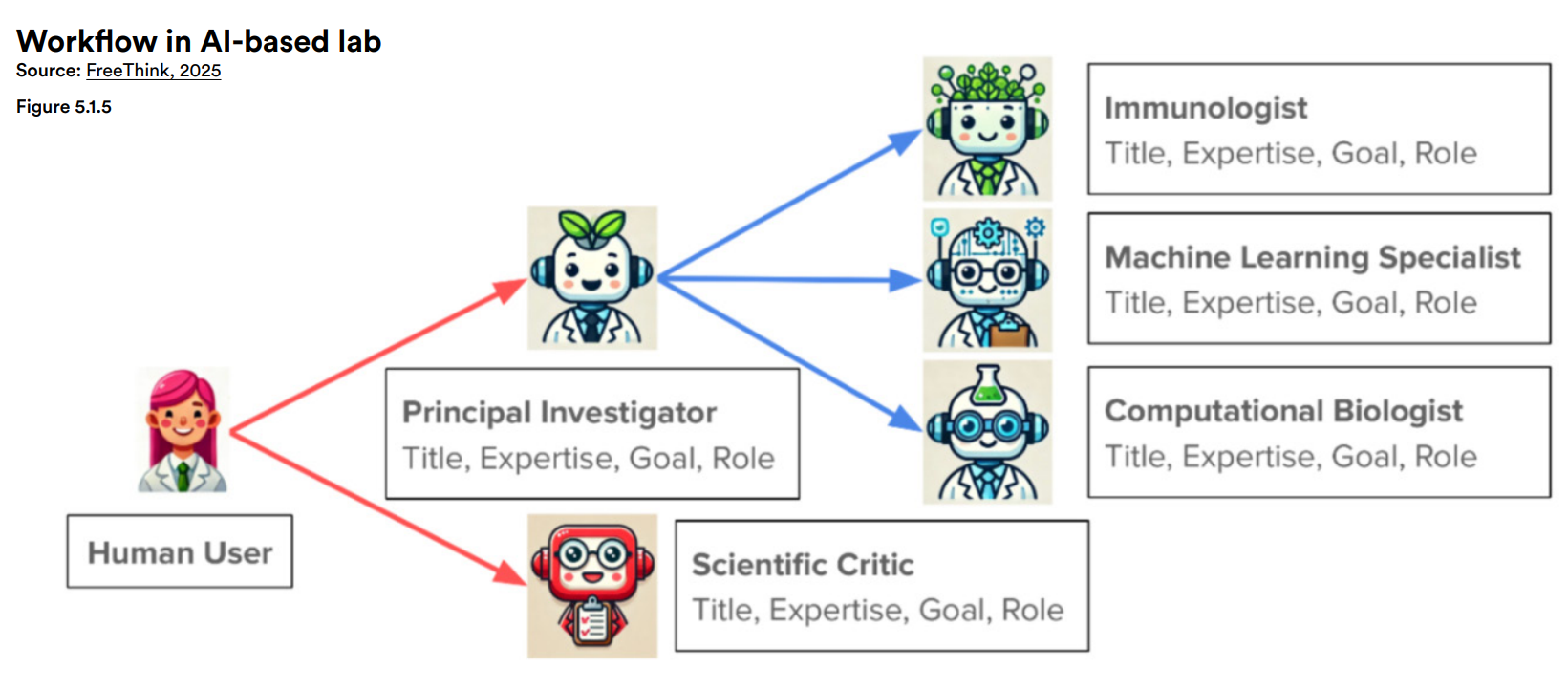
The Virtual Lab is an AI-led research framework where multiple specialized AI agents collaborate to solve biomedical problems, guided by a large language model acting as principal investigator. In a recent demonstration, it designed nanobodies capable of binding to new virus variants.
By combining protein models like ESM, AlphaFold-Multimer, and Rosetta, the system generated and refined candidate molecules across optimization rounds. The final nanobodies were computationally promising and experimentally validated, with many showing strong, specific binding to targets.
This approach represents a major shift in biomedical discovery, not just accelerating research but reshaping how it's done by blending structured experimentation with autonomous design pipelines.
3. AI in Medical Research: Power, Progress, and Persistent Challenges
It is no longer a surprise to see AI models playing a role in medical science. In some research settings, AI is not just helping scientists move faster. It is influencing which questions get asked and how problems are framed.
Large language models are now involved across every part of the research cycle. This figure shows how they support study design, data analysis, literature review, and even result interpretation.
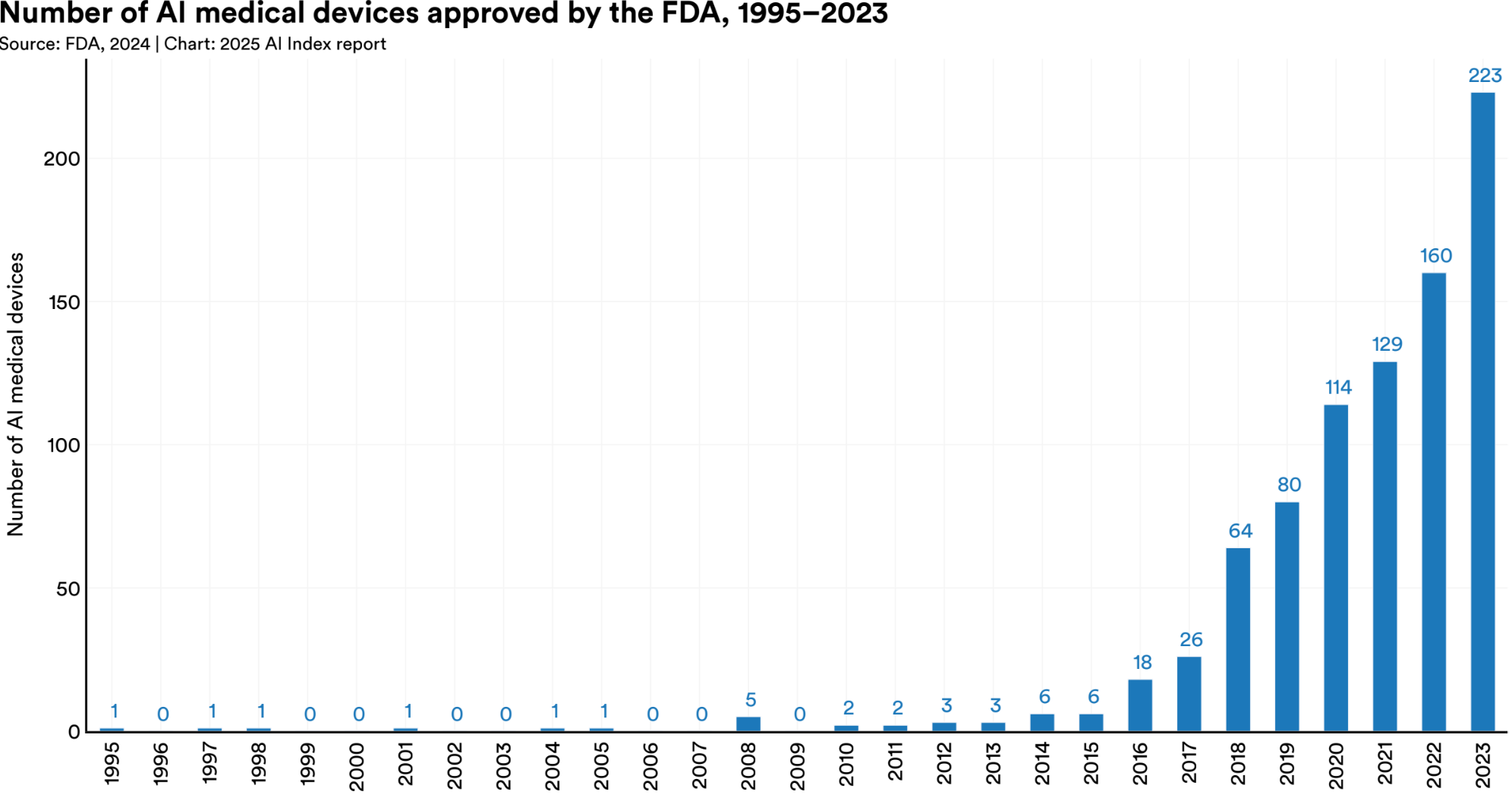
These improvements are not staying in research papers. The number of approved AI tools in medicine has grown dramatically. AI systems are being cleared to assist with medical imaging, decision support, triage, and more. These tools are being used in real hospitals by real clinicians. This figure shows how quickly things are accelerating, the number of AI medical devices approved by FDA is growing exponentially.
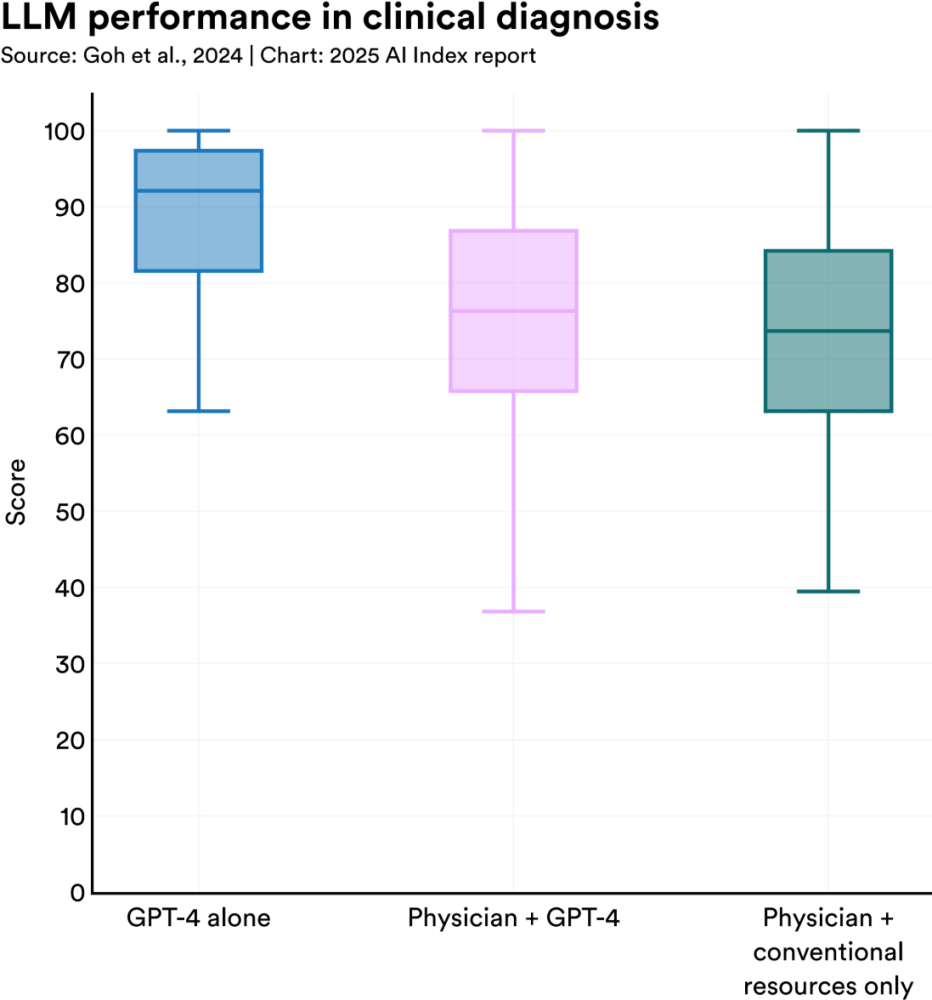
The progress is not surprising. AI models have now outperformed human healthcare professionals in many key medical tasks. In a large-scale evaluation by Google DeepMind, they were tested across diagnostic and treatment planning scenarios, producing decisions that were more consistent and better aligned with clinical guidelines. The figure below shows how performance compared across several benchmarks used in that study.
AI is also becoming more deeply integrated into health records. Models are now embedded into electronic medical systems, surfacing suggestions and risk alerts in real time. This changes how decisions are made. Instead of being buried in files, relevant insights are delivered at the point of care.
Beyond the clinic, AI is starting to address the social conditions that shape health. By analyzing socioeconomic data alongside medical records, it helps identify people at risk because of factors like housing, food access, or financial stress. This allows for more proactive and equitable interventions.
Access to care could also improve as AI tools continue to advance. They have the potential to support healthcare delivery in places that lack specialists, guide non expert providers through complex decisions, and automate parts of the diagnostic process. If these tools are deployed effectively, AI would not just enhance medicine. It would make it more available to more people.
Of course, none of this progress comes without friction. Several challenges continue to limit the impact of AI in medical science:
- Many clinical datasets are still locked away in non digital formats or fragmented across disconnected systems
- High quality labeled data remains limited, especially for rare diseases and underrepresented conditions
- Hallucinations continue to be a risk, particularly when models are missing information or receive unclear prompts
- Many models struggle when operating outside English or when used in multilingual or culturally diverse clinical settings
- Real time integration into clinical workflows remains difficult, slowing down practical adoption in hospitals and clinics
AI in medical science is now powerful, but not polished. It is helping researchers ask better questions, giving clinicians better tools, and giving patients better access. But the real breakthroughs will come not just from what these systems can do in ideal conditions, but from how well we can bring them into the messy, fragmented, high stakes reality of real healthcare.